
Blog
Manufacturing Variables That Control Wood Flooring Performance
Why Manufacturing Moisture Content Matters in Wood Flooring Performance
When wood flooring performs poorly—manifesting as gaps, cupping, cracking, delamination, or surface checking—the installer or jobsite conditions are often blamed. In practice, many failures originate long before installation, during manufacturing. One of the most frequently overlooked variables is moisture content at the time the flooring is produced.
Understanding how your flooring is manufactured—and whether that manufacturing process is compatible with your regional climate—is critical to long-term performance.
Moisture Content Starts at the Mill
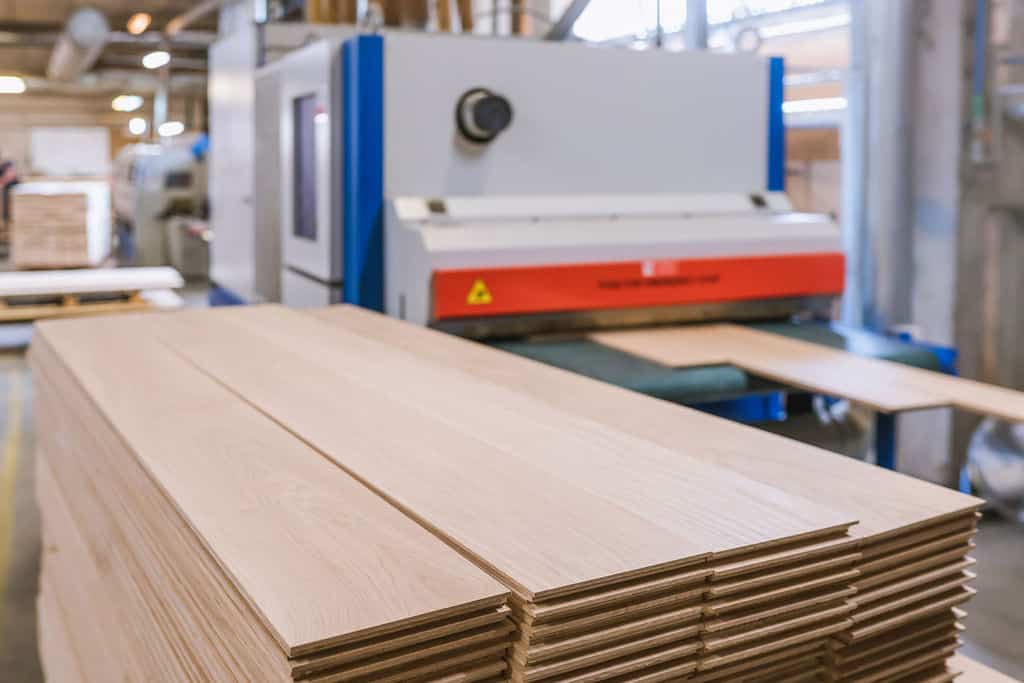
Most wood flooring manufacturers kiln-dry their products to a moisture content range of approximately 6% to 10% prior to milling, finishing, and packaging. This range generally aligns with guidance published by the National Wood Flooring Association (NWFA) and is considered acceptable for average indoor living conditions across the United States.
However, “acceptable on average” does not mean appropriate everywhere.
Wood is a hygroscopic material. It will gain or lose moisture until it reaches equilibrium with its surrounding environment. If flooring leaves the factory at a moisture content significantly higher than what the in-service environment can support, performance issues are not a matter of if, but when.
Regional Climate Matters—Significantly
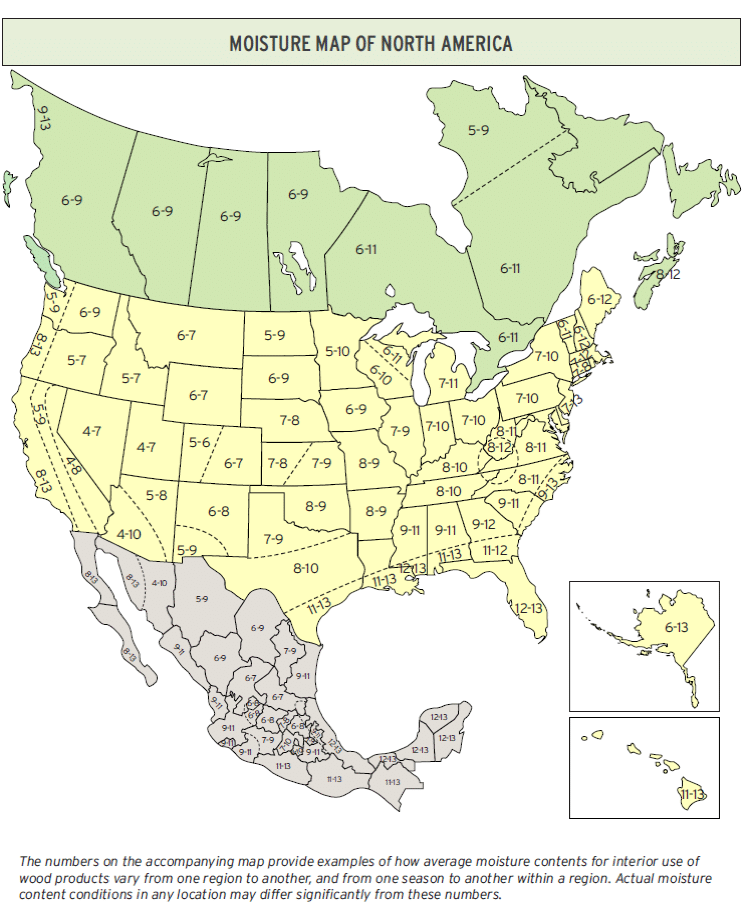
In many parts of the country—particularly arid and semi-arid regions such as the Mountain West, Southwest, and High Plains—the equilibrium moisture content (EMC) of wood in a properly conditioned home is often well below 8%.
- For example:
- Homes in dry climates frequently stabilize at approximately 6%–7% wood moisture content, which is commonly observed along Colorado's Front Range under normal, conditioned living environments.
- Some environments support equilibrium moisture contents as low as 5%–6%, even with active humidification, which is typically observed in Colorado's higher-elevation and mountainous regions.
When flooring manufactured at 8%–10% moisture content is installed into these environments, the wood must lose moisture to reach equilibrium. That moisture loss commonly results in:
- Face checking and veneer cracking (engineered wood flooring)
- End-joint and side-joint gaps (engineered & solid wood flooring)
- Splits through wear layers (engineered wood flooring)
- Dry Cupping (engineered wood flooring)
- Increased stress at glue lines in engineered wood products
- Abnormal gaps (solid wood flooring)
- These conditions are not installation errors. They are predictable material responses to moisture loss.
"Within NWFA Guidelines" is not a Free Pass
NWFA guidelines provide broad national ranges. They do not override regional climate realities, nor do they absolve manufacturers from producing flooring that is appropriate for its intended market.
- A flooring product can be:
- Manufactured within NWFA moisture content ranges
- Installed in accordance with manufacturer instructions
- Still experience in-service failure due to regional incompatibility
- This distinction is critical and frequently misunderstood.
Why This is Rarely Disclosed
- Most consumers are never told:
- The moisture content at which their flooring was manufactured
- Whether that moisture content is appropriate for their geographic region
- The indoor environmental conditions required to maintain dimensional stability
Without this information, homeowners assume the risk—often unknowingly. As the saying goes… if you explain something to somebody beforehand, it’s called education. If you attempt to explain it after the fact, it is called an excuse!
What You Should Ask Before You Buy
Before selecting a wood flooring product—particularly solid or engineered hardwood—ask the manufacturer or retailer:
- What is the target moisture content at manufacturing?
- Is this product intended for my geographic region?
- What indoor humidity range is required to maintain performance?
- What conditions or failures are excluded under the warranty?
- If clear, documented answers are not provided, that should be considered a red flag.
Manufacturer Selection Matters
That said, through repeated field inspections, failure investigations, and long-term performance observations across multiple projects, we have identified certain manufacturers whose products have demonstrated more consistent performance in specific environments. Based solely on past inspection experience, flooring produced by Muscamnelle Mills has, in our observations, exhibited improved dimensional stability and overall performance when installed in dry and semi-arid regions such as Colorado, when compared to many other products evaluated under similar conditions.
The following excerpt is taken directly from Muscamnelle Mills’ published information regarding drying practices:
“Our wood is double-dried in a kiln to be optimal for arid climates. Like most mills, we start with lumber that has been kiln-dried to a 6–10% moisture content. However, with wide plank flooring, this range can leave too much variance between boards. We re-dry to a tighter range of 5–7% moisture content, which is ideal for Colorado. All re-dried stock goes through this process before milling, allowing moisture-related movement to occur prior to final shaping.”
This information is provided for context only and should not be construed as a recommendation, warranty, or guarantee of performance. Proper site evaluation, moisture testing, environmental control, and adherence to manufacturer installation instructions and applicable industry standards remain essential.
Bottom Line
Wood flooring does not fail randomly. It responds to moisture—predictably and relentlessly.
Knowing who manufactured your floor, how it was dried, and whether it is compatible with your environment is just as important as how it is installed.
Floors don’t lie. They tell the story of decisions made long before installation ever begins.
At Advanced Flooring Inspections, we provide pre-installation consulting, on-site inspections, and professional reporting backed by more than 35 years of experience in the flooring industry.

